Fruit Wine & Red Wine Fermentation Equipment: Complete Guide for Modern Wine Production
Introduction to Fruit Wine & Red Wine Fermentation Equipment
Fruit wine and red wine production has evolved significantly with the advancement of fermentation technology. Modern fruit wine & red wine fermentation equipment enables wineries, beverage manufacturers, agricultural processing facilities, and commercial wine producers to achieve consistent quality, higher productivity, and improved process control.
Fermentation is the most critical stage in wine production. During this process, yeast converts sugars into alcohol, carbon dioxide, and a wide range of flavor compounds. The quality of the fermentation equipment directly influences wine aroma, taste, color stability, alcohol content, and overall product consistency.
Fruit wine & red wine fermentation equipment is designed to provide a controlled environment where temperature, pressure, oxygen exposure, and fermentation time can be accurately managed. Whether producing grape wine, apple wine, blueberry wine, strawberry wine, cherry wine, peach wine, or other fruit-based alcoholic beverages, modern fermentation systems help manufacturers optimize production efficiency while maintaining product quality.
This guide explores the features, applications, specifications, advantages, and selection considerations of fruit wine & red wine fermentation equipment.
What Is Fruit Wine & Red Wine Fermentation Equipment?
Fruit wine & red wine fermentation equipment refers to specialized processing vessels and integrated systems used to convert fruit juice or grape must into wine through controlled microbial fermentation.
The equipment generally consists of:
These systems are designed to maintain ideal fermentation conditions throughout the wine production process.
Importance of Fermentation Equipment in Wine Production
The fermentation stage determines many key wine characteristics.
Key Functions
| Function | Purpose |
|---|
| Temperature Control | Maintains ideal yeast activity |
| Oxygen Management | Prevents oxidation |
| Pressure Regulation | Ensures safe fermentation |
| Sanitary Processing | Prevents contamination |
| Mixing and Homogenization | Improves fermentation consistency |
| Process Monitoring | Tracks fermentation progress |
| Product Stability | Ensures uniform quality |
Without proper fermentation equipment, wine producers may face:
Main Types of Wine Fermentation Equipment
Open Fermentation Tanks
Open fermenters are commonly used for certain traditional red wine fermentation processes.
Advantages
Easy cap management
Convenient manual operation
Suitable for small-scale wineries
Traditional winemaking style
Limitations
Closed Fermentation Tanks
Closed fermentation systems are widely used in modern wineries.
Benefits
Jacketed Fermentation Tanks
Jacketed tanks feature external cooling or heating jackets.
Functions
Precise temperature management
Stable fermentation conditions
Energy-efficient operation
These tanks are widely used for:
Variable Capacity Fermentation Tanks
Variable capacity tanks feature adjustable floating lids.
Applications
Components of Fruit Wine & Red Wine Fermentation Equipment
The vessel serves as the primary fermentation chamber.
Common Materials
| Material | Characteristics |
|---|
| SUS304 Stainless steel | Economical and durable |
| SUS316 Stainless Steel | Higher corrosion resistance |
| Food-Grade Alloy Steel | Specialized applications |
Stainless steel remains the most popular choice due to its hygiene and durability.
Cooling Jacket
The cooling jacket helps regulate fermentation temperatures.
Benefits
Prevents overheating
Protects yeast performance
Enhances flavor preservation
Improves color extraction
Agitation System
Mixing systems improve fermentation uniformity.
Functions
Temperature Sensors
Modern equipment integrates digital temperature monitoring.
Features
Sampling Valve
Sampling valves allow operators to collect product samples without contamination.
Benefits
Easy quality control
Reduced product loss
Improved hygiene
Pressure Relief System
Pressure control devices ensure safe operation.
Functions
Fruit Wine Production Process
Step 1: Fruit Selection
Common fruits include:
Apples
Blueberries
Strawberries
Cherries
Peaches
Pears
Plums
Blackberries
High-quality raw materials produce superior wine.
Step 2: Washing and Sorting
Objectives:
Remove impurities
Eliminate damaged fruit
Improve product quality
Step 3: Crushing and Pulping
Fruit is crushed to release juice and fermentable sugars.
Step 4: Juice Extraction
Mechanical extraction systems separate juice from solids.
Step 5: Sugar Adjustment
Sugar levels may be adjusted to achieve target alcohol content.
Step 6: Yeast Inoculation
Selected wine yeast strains are introduced.
Step 7: Fermentation
Fermentation occurs inside controlled fermentation tanks.
Typical Conditions
| Parameter | Range |
|---|
| Temperature | 18-30°C |
| Fermentation Time | 7-30 Days |
| Alcohol Content | 5-18% |
| pH Value | 3.0-4.0 |
Step 8: Clarification
Wine is clarified through settling or filtration.
Step 9: Aging
Depending on wine style, aging may continue for weeks or months.
Step 10: Bottling
Finished wine is packaged for distribution.
Red Wine Fermentation Process
Grape Reception
Fresh grapes arrive from vineyards and undergo quality inspection.
Destemming and Crushing
The grapes are processed to separate stems from berries.
Must Preparation
The grape must contains:
Alcoholic Fermentation
Yeast converts sugars into alcohol.
Typical Conditions
| Parameter | Value |
|---|
| Temperature | 22-30°C |
| Fermentation Time | 5-15 Days |
| Sugar Content | 20-25 Brix |
| Alcohol Yield | 11-15% |
Cap Management
Red wine fermentation requires cap management techniques.
Methods include:
Punch-down
Pump-over
Rotary mixing
Pressing
After fermentation, wine is separated from skins.
Malolactic Fermentation
Secondary fermentation improves wine stability and smoothness.
Aging and Storage
Wine is matured before packaging.
Key Features of Modern Fermentation Equipment
Automated Temperature Control
Advanced control systems maintain precise fermentation temperatures.
Benefits:
Stable fermentation
Consistent flavor
Improved quality
PLC Automation
PLC systems provide:
Automatic operation
Process monitoring
Data collection
Alarm management
CIP Cleaning Systems
Clean-In-Place systems simplify sanitation.
Advantages:
Reduced labor
Faster cleaning
Improved hygiene
Energy-Efficient Design
Modern systems reduce:
Electricity consumption
Water usage
Operating costs
Modular Configuration
Modular systems allow future expansion.
Technical Specifications
Typical Fermentation Tank Specifications
| Item | Specification |
|---|
| Capacity | 500L – 50,000L |
| Material | SUS304 / SUS316 |
| Surface Finish | Mirror Polished |
| Cooling Jacket | Dimple Jacket |
| Design Pressure | 0.2-0.6 MPa |
| Temperature Range | 0-40°C |
| Insulation Thickness | 50-100 mm |
| Control System | Manual / PLC |
| Cleaning System | CIP Compatible |
| Power Supply | Customizable |
Capacity Selection Guide
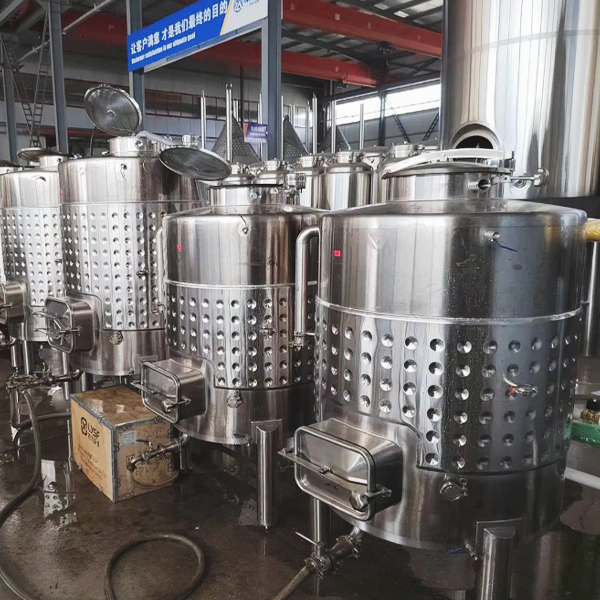
Small Winery
| Daily Production | Recommended Capacity |
|---|
| 500-1,000 L | 1,000-2,000 L Tank |
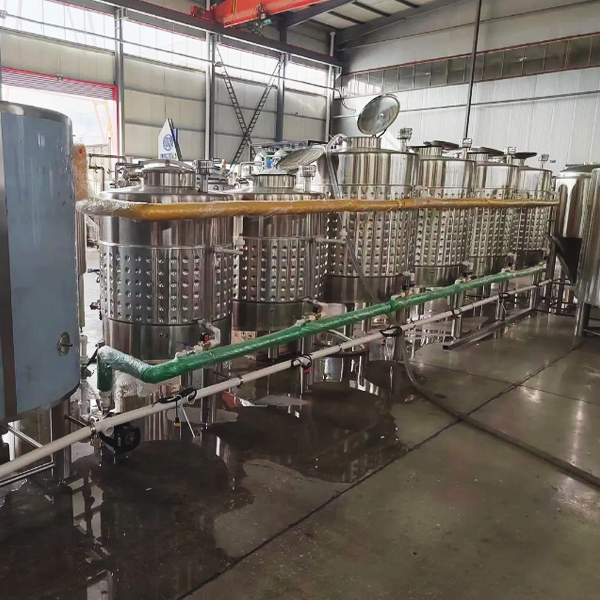
Medium Winery
| Daily Production | Recommended Capacity |
|---|
| 2,000-10,000 L | 5,000-20,000 L Tank |
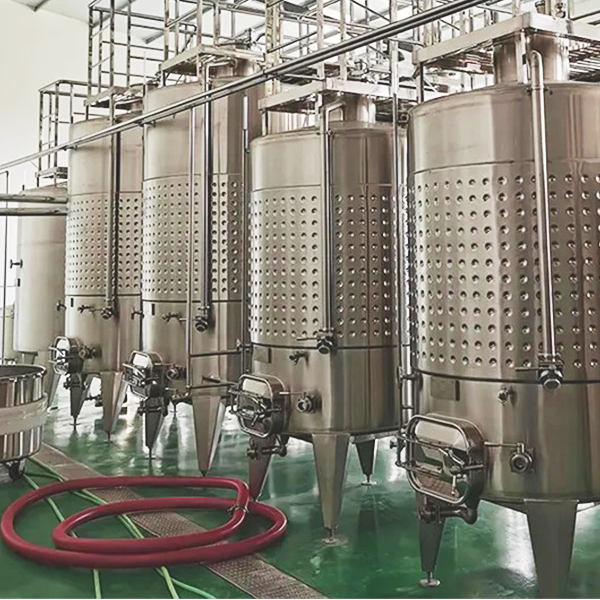
Large Winery
| Daily Production | Recommended Capacity |
|---|
| 20,000+ L | 30,000-50,000 L Tank |
Benefits of Stainless Steel Fermentation Equipment
Excellent Corrosion Resistance
Wine acids can be highly corrosive.
Stainless steel provides long-term durability.
Superior Hygiene
Smooth surfaces prevent bacterial growth.
Easy Maintenance
Minimal maintenance requirements reduce operating costs.
Long Service Life
Typical service life exceeds 15 years.
Applications of Fruit Wine & Red Wine Fermentation Equipment
Commercial Wineries
Large-scale wine production.
Fruit Processing Plants
Seasonal fruit wine manufacturing.
Agricultural Cooperatives
Value-added fruit processing.
Beverage Manufacturing Facilities
Alcoholic beverage diversification.
Research Institutions
Pilot-scale fermentation studies.
Quality Control During Fermentation
Temperature Monitoring
Continuous monitoring ensures yeast health.
Sugar Testing
Brix measurements track fermentation progress.
Alcohol Analysis
Determines production efficiency.
pH Monitoring
Maintains microbial stability.
Sensory Evaluation
Evaluates flavor development.
Common Fermentation Challenges
Stuck Fermentation
Causes
Nutrient deficiency
Temperature fluctuations
Yeast stress
Solutions
Temperature adjustment
Nutrient supplementation
Yeast reactivation
Excessive Foam
Causes
Solutions
Antifoam control
Proper tank sizing
Oxidation
Prevention
Closed tanks
Inert gas protection
Proper sealing
Industry Trends in Wine Fermentation Equipment
Smart Fermentation Technology
Modern wineries increasingly adopt:
IoT monitoring
Remote control
Cloud data analysis
Automated Production
Automation improves:
Efficiency
Product consistency
Labor utilization
Sustainable Manufacturing
Energy-saving equipment reduces environmental impact.
Digital Traceability
Production data can be tracked throughout the process.
Installation Requirements
Foundation
Stable concrete foundations support equipment weight.
Utilities
Required utilities include:
Electricity
Water supply
Cooling system
Drainage
Environmental Conditions
Recommended installation environment:
| Factor | Requirement |
|---|
| Temperature | 5-35°C |
| Humidity | <85% |
| Ventilation | Good |
| Lighting | Adequate |
Maintenance Recommendations
Daily Inspection
Check:
Valves
Temperature readings
Pressure indicators
Weekly Maintenance
Inspect:
Seals
Connections
Cooling systems
Monthly Maintenance
Verify:
Control systems
Sensors
Safety devices
Annual Maintenance
Conduct comprehensive equipment inspection.
How to Choose the Right Fruit Wine & Red Wine Fermentation Equipment
Production Capacity
Determine expected annual production volume.
Product Type
Different wines require different fermentation conditions.
Automation Level
Options include:
Material Selection
SUS304 is suitable for most applications.
SUS316 offers enhanced corrosion resistance.
Budget Considerations
Evaluate:
Initial investment
Operating costs
Maintenance expenses
Future expansion plans
Frequently Asked Questions
What is the ideal fermentation temperature for red wine?
Most red wines ferment between 22°C and 30°C, depending on grape variety and desired flavor profile.
Can the same equipment produce different fruit wines?
Yes. Modern fermentation tanks can process multiple fruit wine varieties after proper cleaning and sanitation.
Why is temperature control important?
Temperature directly affects yeast activity, alcohol production, aroma retention, and wine quality.
What tank material is recommended?
Food-grade stainless steel, particularly SUS304 or SUS316, is the preferred material for commercial wine fermentation equipment.
How long does wine fermentation take?
Fermentation duration typically ranges from 7 to 30 days, depending on fruit type, sugar content, yeast strain, and processing conditions.
Conclusion
Fruit Wine & Red Wine Fermentation Equipment plays a vital role in modern wine production. From small boutique wineries to large industrial beverage facilities, advanced fermentation systems provide the precision, hygiene, efficiency, and consistency required for producing high-quality wines. By incorporating stainless steel construction, temperature control technology, automated monitoring systems, and sanitary design, modern fermentation equipment helps manufacturers optimize production while preserving the unique flavors and characteristics of fruit wines and red wines.
As global demand for premium wine products continues to grow, investing in reliable, efficient, and scalable fermentation equipment remains a key factor in achieving long-term success in the wine and beverage processing industry.
 +86 29-87031531



 โทรศัพท์